The price of perga: why bee bread costs more than honey
Why perga costs far more than honey: bees make little of it, and picking it out by hand takes hours. What sets the price and how to spot a fair offer.
By AndrejaPublished 3 min read
When people see the price of perga (bee bread) for the first time, the first question is always the same: why does a 100-gram pack cost as much as several kilograms of honey? The answer is not in the marketing but in the hive. This is an honest explanation of what lies behind the price.
Bees produce very little perga
Bees store honey in large quantities, because it is their reserve for the winter. A strong hive in a good season can give tens of kilograms of surplus honey. Perga is something else entirely: it is food for the brood and the young bees, and the bees produce exactly as much of it as they need.
Beekeeping sources most often mention just a few hundred grams of perga per hive per year. Of that, the beekeeper may take only a share, because otherwise the brood would be left without food. Add it all up and a single hive yields only a few 100-gram jars in a season.
Taking it out of the comb is manual work
Honey is extracted in a centrifuge: the frames are uncapped, spun, and the honey runs out. Perga is packed tightly into the cells of the comb and covered with honey and wax. It cannot be spun out.
To get to the perga, the beekeeper has to:
- choose the frames on which the perga is ripe and dry,
- remove the layer of wax,
- take the perga out of the cells, piece by piece, without damaging the comb,
- clean the pieces of any wax residue and crumbs,
- dry them under controlled conditions so they do not spoil,
- pack and label them.
That is hours of concentrated work for small quantities. When Josip takes out perga in our oasis, a day’s work yields an amount that, for honey, would be a few minutes of extracting.
Perga is delicate and needs care
Damp perga spoils. Overheated perga loses its value. Stored wrongly, it absorbs moisture. That is why perga is dried slowly, without heating, and kept in a dry, dark place. Every step the beekeeper skips, the customer notices in the quality.
What sets our price
Oaza Bee perga (100 g) costs 108 euros. That price includes:
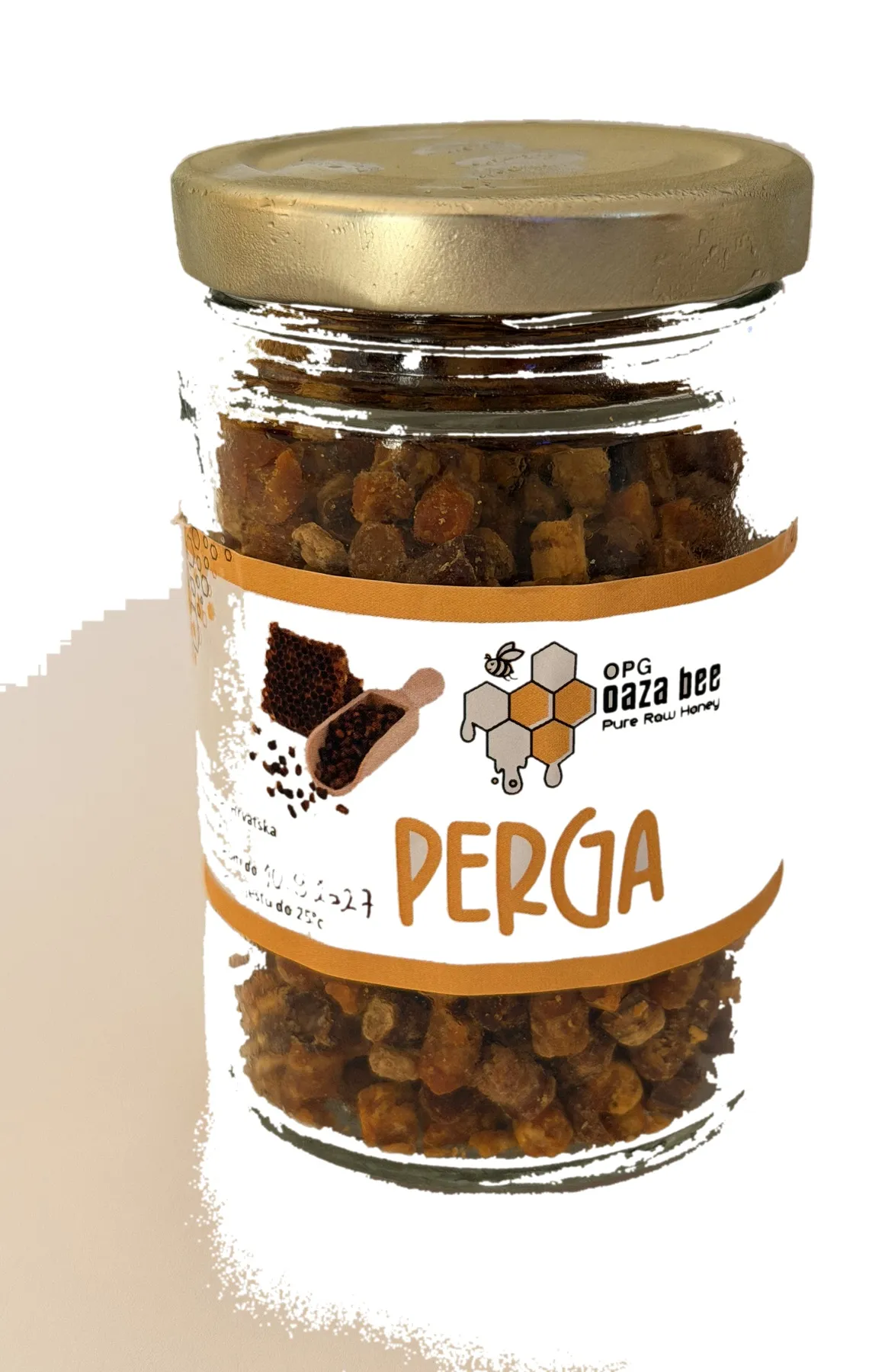
- perga from our own hives in Sokolovac, nothing bought in,
- taking it out and cleaning it by hand,
- drying without heat and packing in glass,
- a label with the beekeeper’s name, address and best-before date.
It does not include storage through middlemen, imports or marketing. You buy directly from the family that takes the perga out.
How to recognise a fair offer
Perga at a suspiciously low price is usually not perga. Most often it is ordinary bee pollen, or imported goods of unknown origin. What to look at:
- Origin and the beekeeper’s name on the label. An anonymous jar is a bad sign.
- Appearance. Perga comes in firm, hexagonal pieces, from light yellow to dark brown. Loose, multicoloured granules are bee pollen.
- Smell and taste. Mildly tart and sweet, reminiscent of honey and dried fruit. Rancid or mouldy means poor storage.
- Filling date and best-before date.
Is it worth it?
With typical use, a 100-gram jar lasts one to two months. For those who want perga in their daily routine, that is the price you pay for a product the bees make once a year, in small quantities, and that someone takes out by hand.
If you would like to get to know perga before you decide, read about what perga is on our perga page, and you can order a jar here. For questions about origin and harvesting, we are happy to help.
Questions and answers
How much does perga cost?
In Croatia, perga is usually sold in 100-gram packs for roughly 90 to 120 euros, depending on the beekeeper. Oaza Bee perga (100 g) costs 108 euros and comes from our own hives in Sokolovac.
Why is perga so much more expensive than honey?
Perga is more expensive than honey because bees produce it in very small quantities, because it is taken out of the comb by hand, cell by cell, and because the beekeeper may only take a share so that the brood is not left without food. One hive gives just a few hundred grams of perga a year, but tens of kilograms of honey.
How long does a 100-gram jar of perga last?
With typical use of one to two teaspoons a day, a 100-gram jar of perga lasts roughly one to two months.
How can I recognise a fair offer of perga?
A fair offer of perga clearly states the origin, the beekeeper's name, the filling date and the best-before date, and the perga itself is dry, in firm hexagonal pieces of varying shades. A suspiciously low price usually means the product is not perga but ordinary bee pollen, or imported goods of unknown origin.